
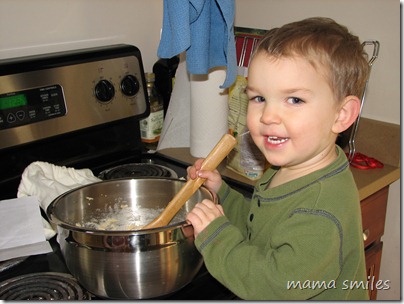
 We’ve been doing a lot of kitchen-based chemistry lately. First, we baked these cookies. My primary motivation in making these was to have cookies to eat, but we also talked about solids and liquids, and how different liquids turn to solids at different temperatures (water vs. butter) and looked at how the texture of the dough changed as we added sugar, then flour, then oatmeal, and finally chocolate chips.
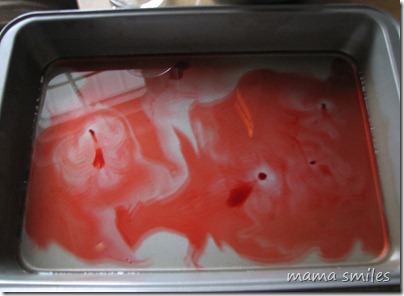 We added food coloring drops to a pan of water and watched them disperse (see this post for a more thorough food coloring and water experiment).
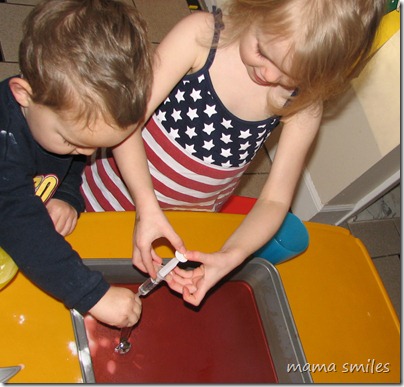
Then I took the same pan of water, gave Emma white vinegar in a cup with a syringe and Johnny baking soda in a cup with a 1/4 teaspoon measuring spoon and had them play around with this acid-base combination (thank you Nicole from Tired, Need Sleep for providing this idea).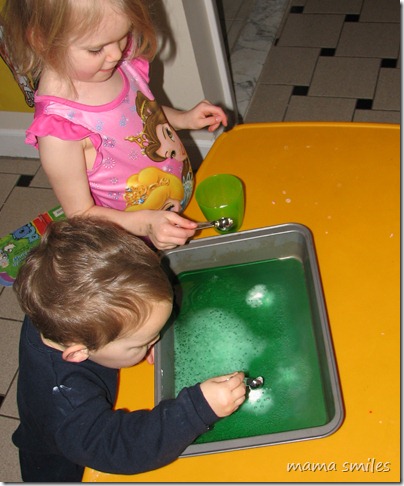
Next, we put white vinegar in the pan (with green food coloring, just for fun) and added baking soda for much more dramatic fizzing.
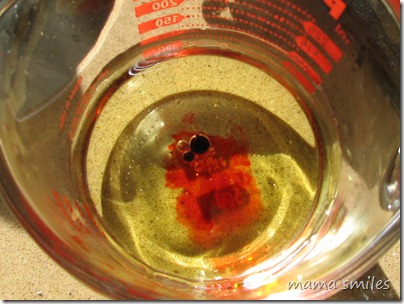
We finished off our kitchen chemistry by making a second batch of play dough (pink this time). We looked at how, when we added food coloring to water and oil, some of the food coloring got caught in the oil and so didn’t disperse as quickly.
 Then we stirred it all up. We talked about how there were still a couple of beads of food coloring in oil that hadn’t gotten mixed in, and about how the big bubble of oil broke up into a bunch of little bubbles but didn’t mix perfectly with the water.
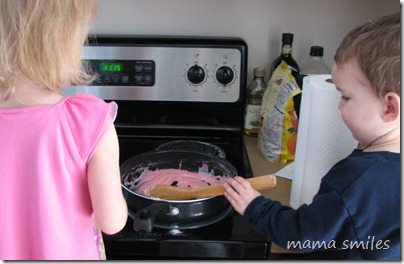
Finally, we baked the play dough. We talked about how the red water/oil mixture turned pink when we mixed it with the white flour, salt, and cream of tartar. We talked about how we put in flour to make the water thick, salt to keep it from sticking to everything, oil to make it feel less grainy from the salt, and cream of tartar to make it more stretchy. And, of course, food coloring to make a fun color. And we all enjoyed watching the mixture change quickly from soup-like to dough-like.
Do you know of any other fun kitchen chemistry activities we can try?

MaryAnne is a craft loving educator, musician, photographer, and writer who lives in Silicon Valley with her husband Mike and their four children.
Bear and i were surfing pinterest. he saw this and went, “OOH! what’s that green stuff?” lol so we’ll be playing with baking soda and vinegar after lunch ;)
I’m so glad Bear thought it looked like fun :)
I will try it! Everytime the kids come along to the obstetrician he gives them these plastic syringes. Good idea for new use! The girls will love it!
The cornstarch and water experiment is fun. Oobleck I think they call it. Anyway, these are all great activities. I need to play with vinegar and baking soda with Bear. I haven’t commented in a while, but I’m still here, lurking :)
.-= Julie´s last blog ..A Guessing Game… =-.
I immediately bookmarked this post! Sunnyboy is going to have great fun trying out these experiments. Thanks you for more wonderful inspiration. :)
.-= sunnymama´s last blog ..Batik Frog Wall Hanging GIVEAWAY =-.
Making ice-cream in a bag is a nice kitchen science experiment – I’ve blogged about it or you can probably find the method by doing an internet search
.-= Catherine´s last blog ..a handful of activities to try with your 12 to 18 month old toddler =-.
I didn’t read all the comments but did boiling ice get mentioned? We love to do that. Boil water, add ice cubes.
.-= Andrea @ The Train To Crazy´s last blog .. =-.
what fun experiments!! Our favorite is gak – cornstarch, water & food coloring.
.-= Beth´s last blog ..rock star finish!!!!! =-.
It’s so impressive that you take the time to have these conversations while you are doing things in the kitchen – good for you! I need to do more of that with M. BTW, I should’ve mentioned in my vinegar/baking soda post that we only used a little bit of water, and we did end up using a lot more vinegar – the dramatic foaming is the best!
These are all great ideas!
Not an experiment per se, more of a sensory experience, but soap bubbles are good (clean!) fun. Just the feel of the bubbles, mixing to make them thicker, blowing bubble clouds…
.-= Elisa | blissfulE´s last blog ..toilet training Lex =-.
What great ideas!
.-= lynn´s last blog ..Heart to Heart: Back to Back Valentine’s Day Crafts and Some Companion Books =-.
This is awesome Mary Anne! I love all that you did. That green pan looks so cool to me!
Hanna and Joe would love all that you did with the food coloring and vinegar, oil and so forth.
Thanks for sharing this!
.-= Susana´s last blog ..Milk Jug Pteranodon and More Dino Books! =-.
Oh, and again with the matches — or better yet, just use a lamp — fun with invisible ink…
.-= Karin @ madebyk´s last blog ..Continuous Family Calendar =-.
What fun! Reminds me I need to make more playdough.
As for other activities to try, we’re gearing up to do our “Kitchen Scientist” badge in AHG so I’ve got lots of these ideas swirling in my head:
*taste tests — seeing if you can close your eyes and guess what you’re eating; if they’re old enough, mapping out the taste bud areas on your tongue…
* LiEr mentioned chromotography with coffee filters. what about other things like celery, carnations, etc in colored water
* see if hot vs cold water affects how drops of food color disperse
* if you can find the right kind of bottle/carafe and don’t think the kids are too little to do experiments near matches, the egg-into-the-bottle trick is pretty cool to see. (light a match, throw it into a wide-mouthed bottle, put a hardboiled egg on top; as the match burns away the oxygen, a vaccuum is created which sucks the egg in)
.-= Karin @ madebyk´s last blog ..Continuous Family Calendar =-.
Wow! I am impressed by all the science you packed in – not sure I could explain it all to my kids, but I know they’d have a blast with the baking soda/vinegar one :-)
.-= Kara´s last blog ..Stages of Acceptance: Cold Chinese Pasta Salad, revisited =-.
excitement, not excited. Can’t speak English, clearly!
.-= Sadia´s last blog ..Whole =-.
Oh, how fun! This isn’t kitchen-y, necessarily, but Mel, Jess and I do “sink or float” experiments. We make a hypothesis about whether things will sink or float in water, and then test our hypotheses. Also, for added excited, you can float oil on water, and then see whether some things that float on the water sink in the oil. (It’s a good use for that rancid bottle of olive oil in my cupboard!)
.-= Sadia´s last blog ..Whole =-.
This is perfect for young children – a science that they can touch, smell and even taste. I think making jello would be another fun activity to try or maybe milk with color swirling. I also think that any “ocean in the bottle” type things look magical to children. I haven’t tried much here myself – I keep telling myself that my daughter will probably appreciate them even more when she is a bit older.
.-= Natalie´s last blog ..StArt – A Penguin Story =-.
what a fun Mom you are. Cookies sound good right about now. Yum
.-= Beverly´s last blog ..Wordless Wednesday- Chase me baby Shriek =-.
Chromatography with coffee filters! Different solvents and food coloring or marker inks. Wouldn’t it be fun (time and youngest child permitting) to separate natural dyes? Like beetroot? Actually, I don’t know if a natural dye like beetroot would separate. Hm.
.-= LiEr´s last blog ..Narnians sewing =-.
I love it!
.-= Paula´s last blog ..Morning Devotionals =-.
Such cute little scientists :) What about melting ice with salt? That’s always interesting.
.-= Keeling´s last blog ..Peanut Butter Playdough =-.